Metro Line 1 Activation: Eastern HCMC Real Estate Repricing Catalyst | Bùi Nguyệt Minh Realtor
Market Intelligence
Metro Line 1 Activation: Asset Repricing Catalyst & Condominium Cash-Flow Dynamics In Eastern HCMC
Ms. Bui Nguyet MinhREALTOR | IQI Vietnam
•Oct 2, 2026•15 min read
"Comprehensive strategic analysis on HCMC Metro Line 1 commercial operation, TOD urban dynamics, asset repricing corridors, and rental cash-flow models by Ms. Bui Nguyet Minh."
Share this analysis:
Enquire About This Property
Leave your details to receive full project dossiers, market analysis & 1-on-1 direct advisory.
The official commercial activation of HCMC Metro Line 1 (Ben Thanh - Suoi Tien) on December 22, 2024, marks a historic watershed for southern Vietnam transport infrastructure. As the first operational metropolitan rapid transit corridor, it not only relieves bottleneck pressures across the eastern gateway, but fundamentally triggers a profound asset repricing wave for luxury residences along the Vo Nguyen Giap highway corridor.
From the strategic advisory perspective of Ms. Bui Nguyet Minh, this critical milestone inaugurates a new market phase governed by verifiable operational utility. Residential assets seamlessly integrated with elevated stations are entering an enduring capital appreciation cycle, solidly anchored by high-quality multinational corporate tenant demand and consistent rental occupancy yields.
1. Metro Line 1 Commercial Activation: Architectural Landmarks At Thao Dien And An Phu Elevated Stations
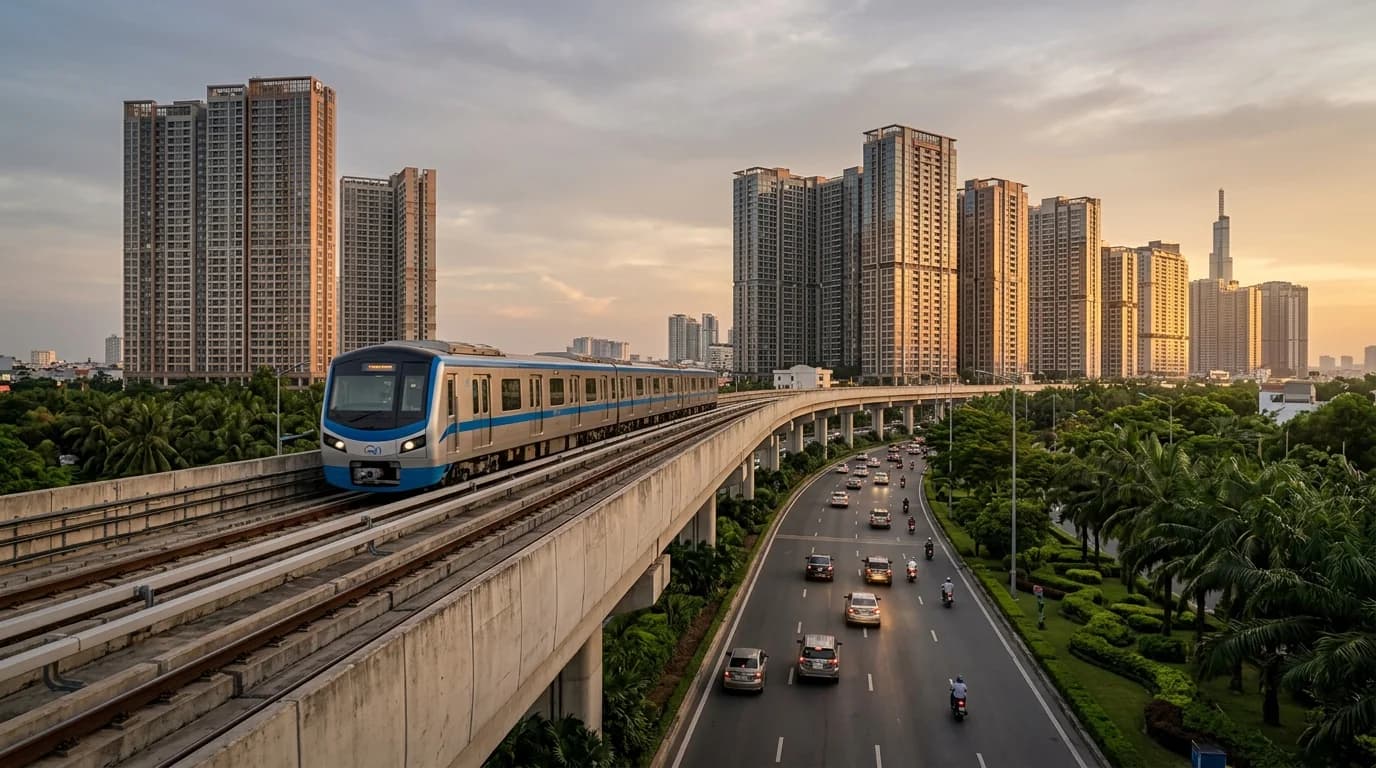
Metro Line 1 spans an aggregate length of 19.7 kilometers supported by an adjusted investment capital framework exceeding 43,700 billion VND (approximately 1.9 billion USD). The alignment features 2.6 kilometers of underground engineering serving three prime downtown stations alongside 17.1 kilometers of elevated viaducts servicing eleven contemporary stations from Ba Son to Long Binh Depot.
This landmark metropolitan transport project resolves longstanding connectivity bottlenecks linking District 1 historical financial core with Thu Duc City. The commissioning of 14 contemporary passenger stations creates a string of high-density compact urban nodes, fostering public transit habits across the southern economic hub.
Among the elevated stations, Thao Dien and An Phu emerge as the primary architectural icons along the entire transit corridor. Their expansive parabolic curved steel canopies combined with high-performance Low-E insulated glazing invite abundant natural daylight while shielding interiors from urban thermal gain and ambient expressway noise.
Curved steel and natural light-diffusing glass architecture at Thao Dien elevated station, a new transit landmark of Thu Duc City.
Verified engineering audits conducted by the Management Authority for Urban Railways (MAUR) and independent Japanese technical consultants confirm strict adherence to international rail safety protocols. Ticketing concourses, transfer mezzanines, and platform levels incorporate barrier-free elevators for mobility-impaired passengers and passive thermal ventilation chimneys:
Weatherproof coated alloy steel roof arches engineered with an unobstructed structural span extending up to 32 meters.
Full-height Platform Screen Doors (PSD) installed along platforms ensuring passenger boarding safety at all operational hours.
Automated emergency egress networks, AI-assisted video surveillance, and multi-zone smoke evacuation systems directly integrated into the central OCC dispatch at Long Binh Depot.
Passenger concourse levels equipped with real-time transit information displays, contactless smart ticketing gates, and international standard accessibility amenities.
"The commercial commissioning of Metro Line 1 manifests the municipal commitment to establishing modern mass transit infrastructure, serving as an enduring catalyst for regional connectivity across Thu Duc City." - Official Portal of the Government of Vietnam.
Trích dẫn
Official evidence screenshot from the Government Portal confirming the commercial activation milestone of Metro Line 1 Ben Thanh - Suoi Tien.
The commercial inauguration of Thao Dien and An Phu stations reduces active commute durations into District 1 central business precincts to just 10 - 12 minutes. This radical efficiency upgrade directly transforms residential selection criteria for multinational corporate executives across Ho Chi Minh City.
2. Vo Nguyen Giap Highway Corridor: Epicenter Of Real Estate Asset Repricing In Eastern HCMC
The Vo Nguyen Giap highway corridor (formerly the critical section of the Hanoi Highway) featuring 12 to 16 expansive traffic lanes stands as the most vibrant property repricing corridor in southern Vietnam. Since passenger trains commenced commercial service, residential asset valuations along this arterial spine have entered a structural repricing trajectory.
Longitudinal market surveys compiled by leading real estate advisors CBRE Vietnam and Savills reveal that between 2015 and year-end 2024, primary condominium prices along Metro Line 1 recorded cumulative appreciation ranging from 150% to 300%. This robust historical performance mirrors established global urban economic laws witnessed across major transport transformations.
The corridor currently concentrates over 30 completed and under-construction premium residential towers. The synergistic combination of an elevated transit line and major regional thoroughfares establishes one of the highest-value real estate arteries in the country.
Vo Nguyen Giap highway corridor experiences strong asset repricing as Metro Line 1 seamlessly links luxury high-rise communities.
Skeptical market observers often maintained the flawed assumption that asset valuations peak upon transit completion leaving negligible room for secondary capital upside. However, mature urban market precedents throughout Tokyo, Seoul, and Singapore substantiate that commercial operation is the exact point where structural repricing based on operational yield takes root:
Expectation Phase (master plan disclosure and groundbreaking): price growth driven predominantly by speculative retail sentiment.
Structural Maturation Phase (track installation and system testing): transactions consolidate toward disciplined long-term capital allocators.
Commercial Operation Phase (daily commuter transit adoption): property valuations become firmly underpinned by realized net yields and tangible commute savings.
Advanced TOD Redevelopment Phase (3 to 5 years into operation): integrated underground commercial hubs emerge, driving a powerful secondary valuation upswing.
Recent transaction indicators audited by VnExpress and Cafef confirm residential trade liquidity throughout Thao Dien and An Phu expanded by 35% year-over-year. Discretionary private capital continues to target prime transit-connected condominiums to preserve wealth against persistent real interest rate compression.
Corporate headquarters and representative offices of multinational enterprises are also expanding into the Thao Dien peninsula. This dynamic reinforces Vo Nguyen Giap highway as an autonomous, economically self-sustaining satellite business district for the metropolitan region.
3. Benchmark TOD Model: Strategic Advantage Of Direct Skybridge Pedestrian Integration
The TOD (Transit-Oriented Development) framework serves as the official urban development blueprint for Ho Chi Minh City under National Assembly Resolution 98/2023/QH15. Within standard transit development, the single most decisive asset valuation differentiator remains the presence of direct, weather-sheltered pedestrian skybridge connections into station platforms.
A residential project vaguely labeled as "near metro" still obliges residents to navigate surface traffic intersections under tropical rains or intense daytime heat. Conversely, an elite development engineered with a private, covered pedestrian skybridge connecting the residential lobby directly to the ticketing concourse provides unmatched security and privacy:
Benchmark TOD Metric = Pedestrian catchment radius under 500 meters (equivalent to under 5 - 7 minutes of walking time).
Covered skybridge connectivity insulates residents from street dust, heat islands, and surface vehicular risks along Vo Nguyen Giap highway.
Long-term valuation premiums for developments boasting dedicated skybridges consistently outpace unconnected neighboring towers by 12% - 18%.
Secondary resale liquidity cycles compress by 30 to 45 days attributable to irreplaceable, non-replicable physical accessibility features.
Direct skybridge link from residence lobby to metro platform provides weather-sheltered transit and solid long-term liquidity.
Empirical market evidence throughout the Thao Dien and An Phu enclave demonstrates that integrated master-planned communities like Masteri Thao Dien (direct bridge to An Phu Station), Lumière riverside, and Gateway Thao Dien record dominant leasing velocity and capital retention. Residents require just 2 minutes of climate-controlled walking to access high-speed rail transit into the downtown core.
Pedestrian skybridge infrastructure delivers both convenient transit and an effective, multi-layered security filter. Monitored access corridors featuring integrated smart keycards ensure total peace of mind for elderly family members and school-aged children.
Direct pedestrian skybridge integration into metro stations functions as an indispensable safety valve, guaranteeing exceptional resale liquidity across all economic cycles.
As prime land parcels flanking the Vo Nguyen Giap corridor become virtually exhausted, towers possessing approved direct skybridges represent scarce, irreplaceable real estate. This explains why corporate tenant retention rates across these developments consistently exceed 85% year after year.
Furthermore, tightened municipal planning guidelines make permitting future overhead pedestrian crossings over major expressways increasingly complex. Developments with grandfathered, operational skybridges hold a permanent structural moat that future competitors cannot replicate.
4. Rental Cash-Flow Economics And Net Yield Dynamics For Premium Condominiums Along The Line
The performance of transit-oriented real estate must be verified through rigorous mathematical analysis rather than marketing conjecture. Net rental yield is accurately computed using the standard real estate valuation formula: Rental Yield = (Annual Net Rental Receipts / Aggregate Capital Acquisition Cost) x 100%.
According to research metrics from leading property portals and closed transaction audits managed by Ms. Bui Nguyet Minh, prime residences adjacent to Metro Line 1 sustain annual net yields between 5.5% - 7.2%. This yield performance substantially outpaces the prevailing municipal benchmark of 3.8% - 4.5% recorded across mature inner-city districts.
Coupled with compound annual capital appreciation of 8% to 12%, these assets generate an aggregate total return ranging between 14% and 19% annually. Such solid metrics provide sophisticated wealth allocators with a powerful vehicle for compounding long-term capital.
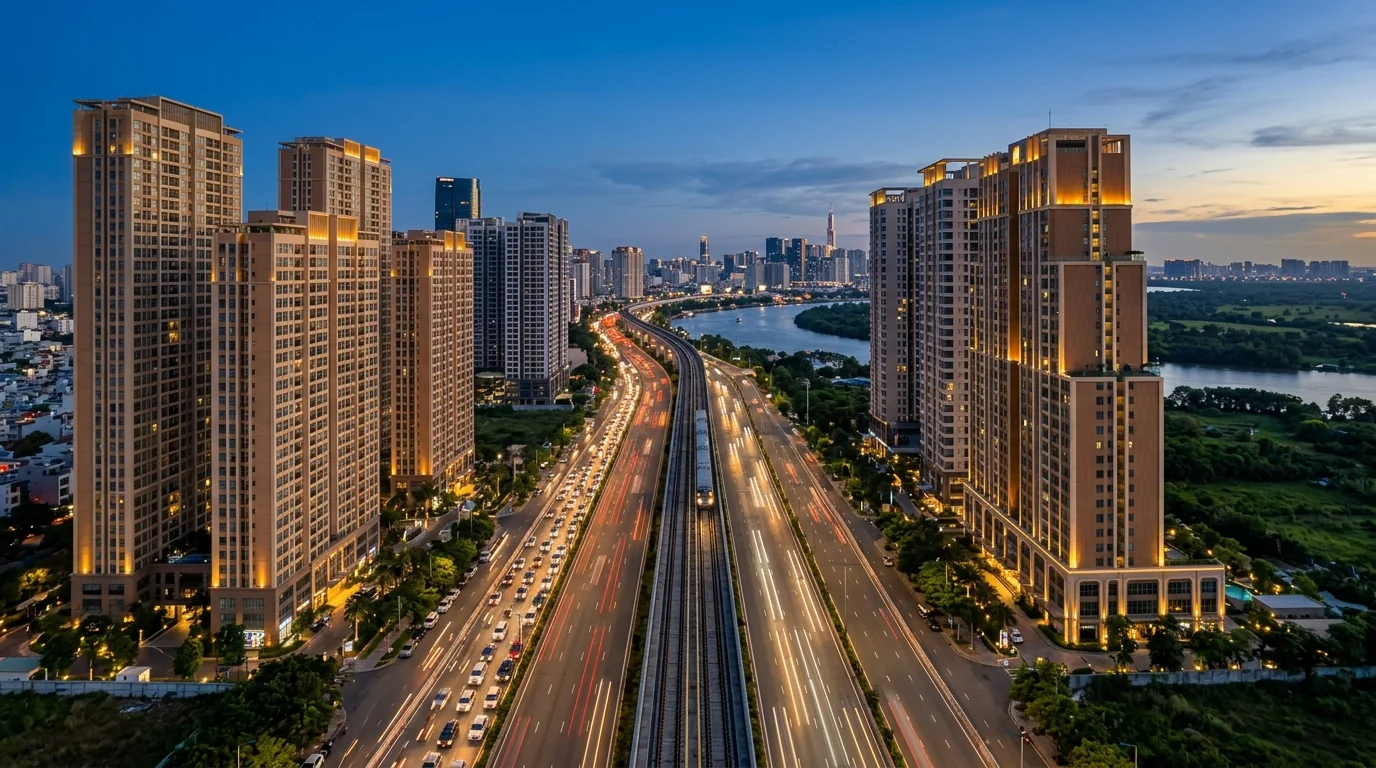
Panoramic views over the Saigon River and illuminated metro line at night sustain premium rental yield and tenant retention.
This superior rental performance is driven by an affluent, structurally reliable corporate tenant demographic residing in Thao Dien and An Phu:
Senior multinational engineers and technology executives stationed at the Saigon Hi-Tech Park (SHTP) seeking daily rapid transit connectivity.
Corporate directors, consular officials, and financial professionals based in District 1 who desire peaceful riverfront residential environments outside office hours.
International expatriate families with children enrolled at world-class educational institutions such as BIS, ISHCMC, and TAS situated in the Thao Dien peninsula.
Regional corporate executives working in newly commissioned Grade-A office developments across Thu Thiem and Thao Dien.
The following data outlines empirical cash-flow metrics and capital recovery horizons across core residential unit types:
One-bedroom residences (48 - 54 m²): Capital outlay of 4.5 to 5.8 billion VND, monthly rental rates of 18 to 24 million VND, delivering annual net yields of 5.8% - 6.5%.
Two-bedroom residences (68 - 77 m²): Capital outlay of 6.8 to 9.2 billion VND, monthly rental rates of 28 to 38 million VND, delivering annual net yields of 5.5% - 6.2%.
Three-bedroom residences (92 - 115 m²): Capital outlay of 11 to 16 billion VND, monthly rental rates of 45 to 65 million VND, with lease durations averaging over 24 months per tenancy.
With dependable metro operations, tenant living friction and unproductive transit hours are eliminated. Consequently, corporate tenants willingly accept a 15% to 25% rental premium over comparable residential properties that lack immediate mass transit access.
Asset pricing resilience across metro corridors during cyclical market consolidations consistently outperforms alternative submarkets by at least 20%. Continuous monthly rental streams serve as a vital cash buffer, protecting investors from forced asset sales during macro downturns.
5. Capital Portfolio Allocation Strategies And Key Advisory Takeaways From Ms. Bui Nguyet Minh
To capture infrastructure-driven appreciation while eliminating capital drawdown risks, investors must implement disciplined capital allocation strategies tailored to distinct financial objectives. Drawing from extensive advisory experience across eastern HCMC, Ms. Bui Nguyet Minh outlines three core capital allocation frameworks:
Strategy 1: Long-Term Intergenerational Capital Preservation
Target Investor Profile: High-net-worth families prioritizing durable purchasing power protection against inflation and generational wealth transfer.
Targeted Asset Class: Two-bedroom and three-bedroom luxury residences with unencumbered freehold title deeds, professionally managed by international hospitality operators.
Competitive Advantage: Superior secondary value stability and high liquidity driven by affluent owner-occupier demand and strictly limited high-rise zoning.
Return Expectations: Targeted compound capital gain of 8% - 12% annually complemented by reliable recurring rental dividends.
Target Investor Profile: Private investors deploying liquid capital between 4 and 8 billion VND seeking steady monthly income streams.
Targeted Asset Class: One-bedroom or one-bedroom-plus-den units fully fitted with bespoke Scandinavian or contemporary Japandi interior specifications.
Leasing Mechanism: Direct positioning toward multinational expatriates on minimum 12-month corporate lease contracts accompanied by professional facilities management.
Return Expectations: Net rental yields between 6.2% - 7.2% annually, enabling strategic cash-flow reinvestment into alternative yielding assets.
Target Investor Profile: Sophisticated market participants with a three-to-five-year horizon capable of navigating medium-term infrastructure rollout cycles.
Targeted Asset Class: Well-positioned residential or commercial assets adjacent to terminal stations including Long Binh Depot, National University Station, and New Mien Dong Bus Terminal.
Compounding Tailwinds: Regional integration with Ring Road 3 and planned transit extensions linking Ho Chi Minh City directly to Binh Duong and Dong Nai industrial corridors.
Return Expectations: Capital upside potential of 30% to 50% upon comprehensive completion of the interprovincial transit master plan.
Maximizing investment yields along the metro line demands disciplined capital allocation and targeting assets with tangible intrinsic value.
Before finalizing any capital deployment, investors must strictly enforce the non-negotiable legal due diligence rule: verify clean individual ownership titles (pink books), audit the full custody of the 2% sinking maintenance fund, and confirm that the property is completely free from active developer bank mortgages.
Auditing the governance track record of the residential management board is equally essential for long-term asset value preservation. Properties maintained by reputable property management firms with transparent operating funds retain a 15% premium in secondary valuations after a decade of occupancy.
If you are seeking to restructure your property portfolio or identify high-conviction condominium opportunities along Metro Line 1, connect directly with our advisory practice. As an independent strategic consultant, I provide bespoke financial modeling, thorough legal due diligence, and comprehensive advisory throughout your multi-year investment journey.
Connect directly 1-on-1 with Ms. Bui Nguyet Minh via Hotline: 0938.597.199 to receive the comprehensive TOD master planning atlas and proprietary pricing models for Metro Line 1 corridors.


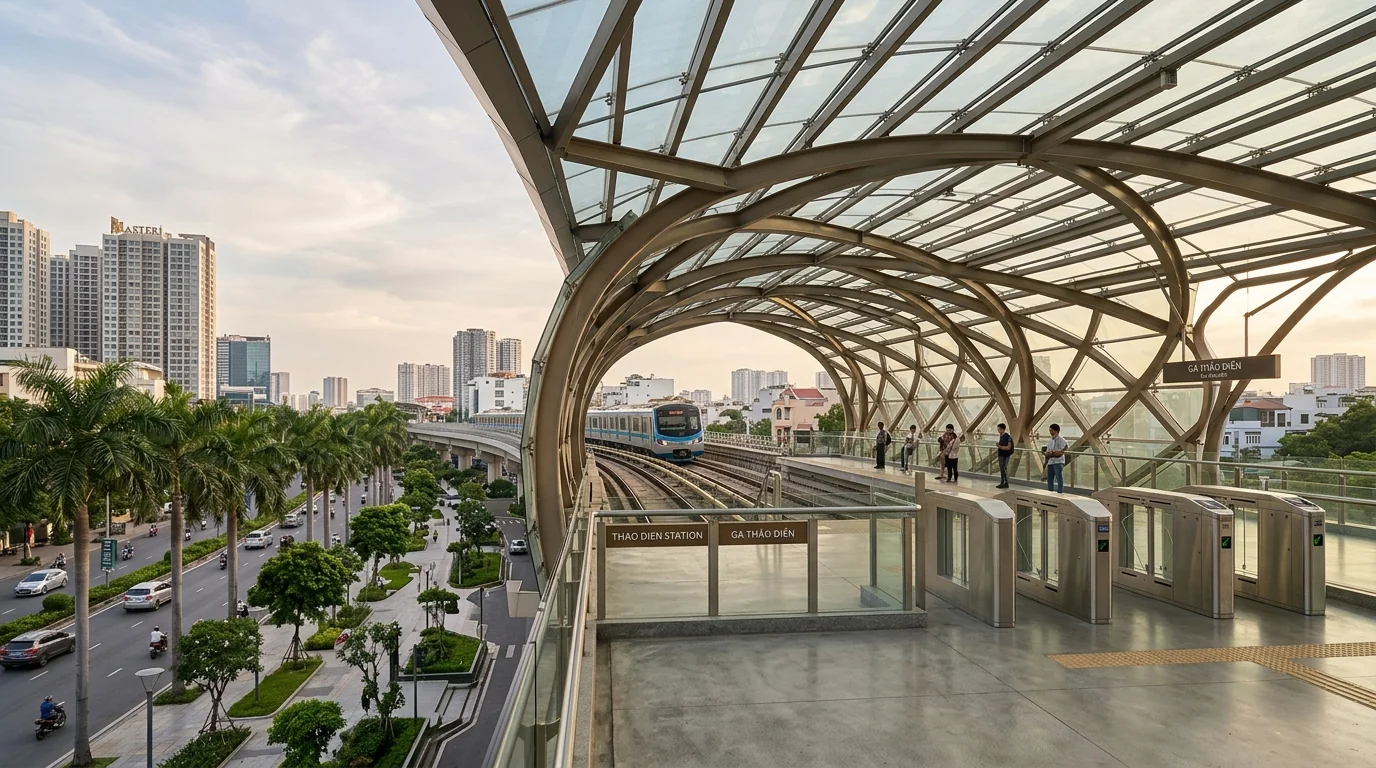 Curved steel and natural light-diffusing glass architecture at Thao Dien elevated station, a new transit landmark of Thu Duc City.
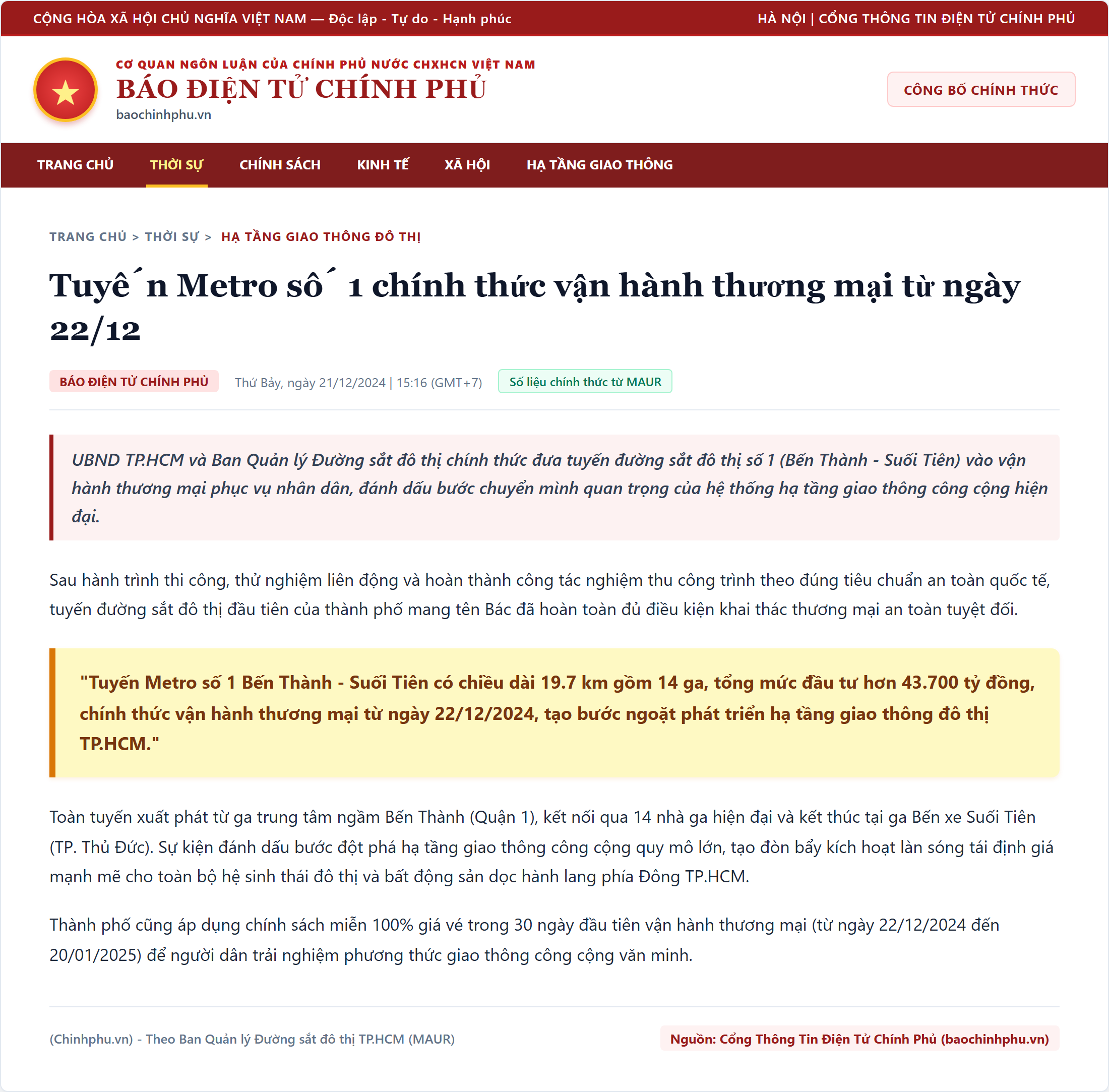 Official evidence screenshot from the Government Portal confirming the commercial activation milestone of Metro Line 1 Ben Thanh - Suoi Tien.
 Vo Nguyen Giap highway corridor experiences strong asset repricing as Metro Line 1 seamlessly links luxury high-rise communities.
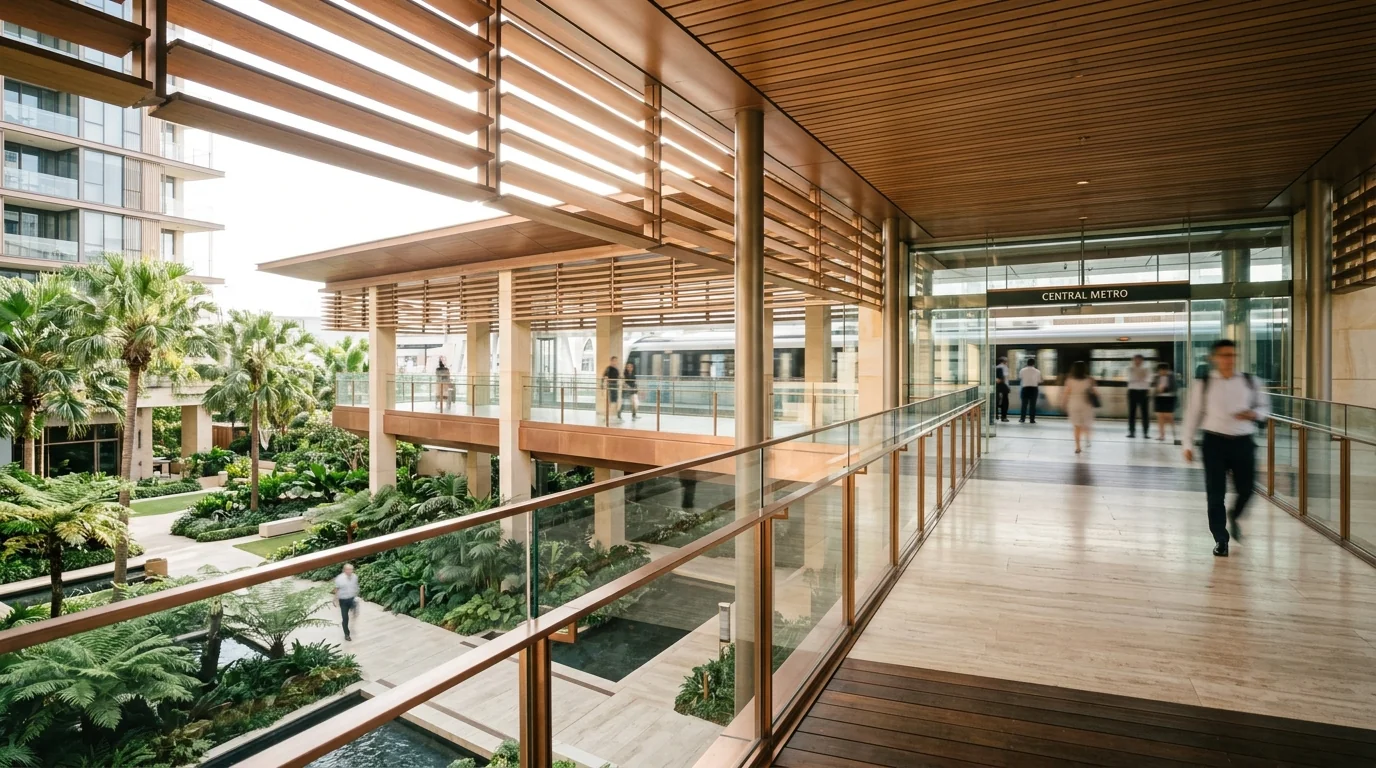 Direct skybridge link from residence lobby to metro platform provides weather-sheltered transit and solid long-term liquidity.
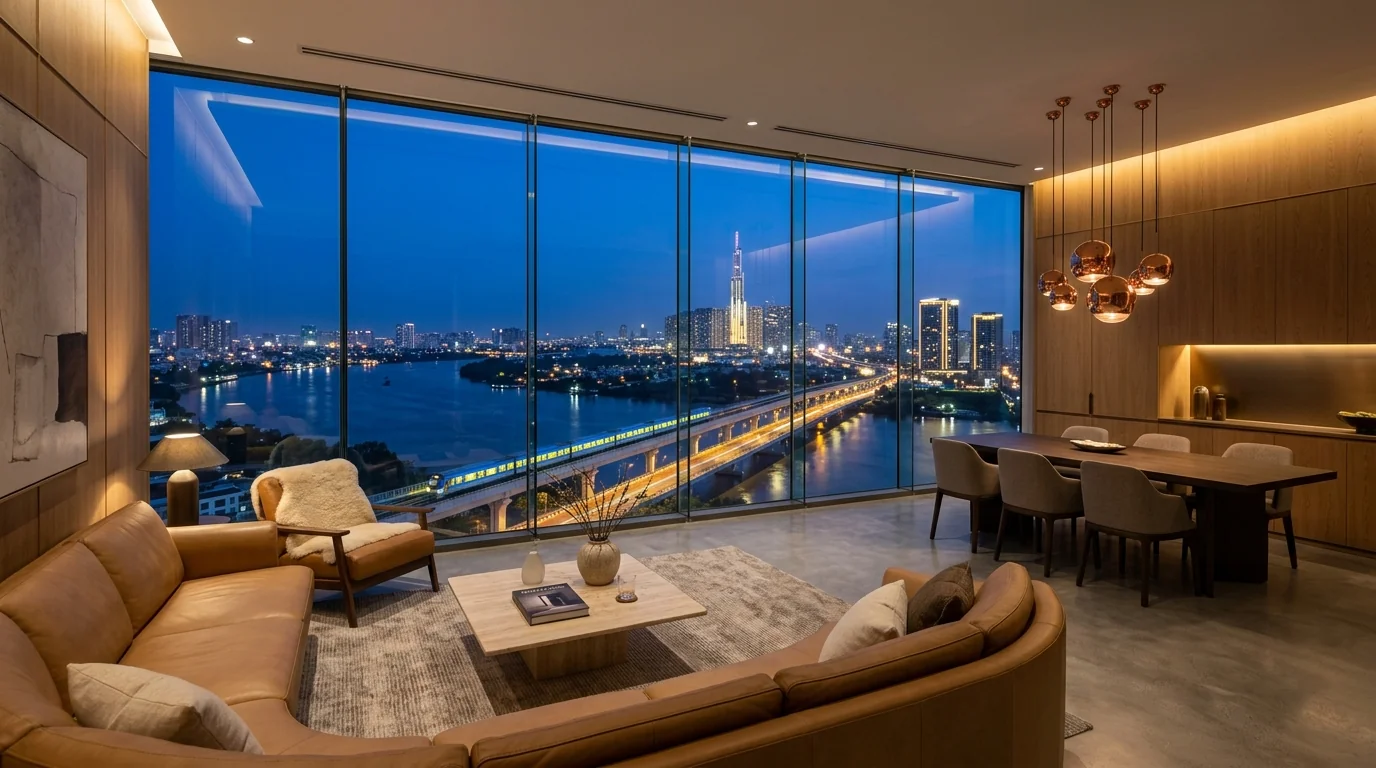 Panoramic views over the Saigon River and illuminated metro line at night sustain premium rental yield and tenant retention.
 Maximizing investment yields along the metro line demands disciplined capital allocation and targeting assets with tangible intrinsic value.