Nhat Tan - Noi Bai Planning & Dong Anh Luxury Real Estate 2026: Tu Lien Bridge & $4.2B Smart City | Bùi Nguyệt Minh Realtor
Market Analysis
Nhat Tan - Noi Bai Planning & Dong Anh Luxury Real Estate 2026: Tu Lien Bridge & $4.2B Smart City
Ms. Bui Nguyet MinhREALTOR | IQI Vietnam
•Oct 1, 2026•11 min read
"Analysis of the Nhat Tan - Noi Bai axis, Tu Lien Bridge catalysts, and the $4.2B Smart City, shaping safe 2026 Dong Anh luxury real estate strategies for elite investors."
Nhat Tan - Noi Bai Planning & Dong Anh Luxury Real Estate 2026: Tu Lien Bridge & $4.2B Smart City
The strategic expansion of Hanoi toward the northern bank of the Red River represents the most transformative urban restructuring in Northern Vietnam over the past two decades. Anchored by the central Nhat Tan - Noi Bai development corridor, the upcoming Tu Lien Bridge, and the $4.2 billion North Hanoi Smart City featuring the iconic 108-story Financial Tower, Dong Anh District is evolving from a suburban administrative unit into the capital primary financial and innovation hub. For discerning private investors and institutional capital allocators, this presents an unprecedented opportunity for strategic wealth preservation, requiring uncompromising legal due diligence and conservative financial structuring.
1. Nhat Tan - Noi Bai Boulevard: The Innovation Spine and International Gateway
Spanning 11.7 kilometers with a generous road cross-section ranging from 70 to 100 meters, the Nhat Tan - Noi Bai development axis along Vo Nguyen Giap Boulevard serves as the most advanced foreign trade and diplomatic corridor in Northern Vietnam. It provides seamless international connectivity between Noi Bai International Airport, West Lake, and the historic Ba Dinh political center. The comprehensive master planning of this corridor establishes an integrated smart urban ecosystem designed to support high-value economic growth through 2030.
Under the detailed 1/500 zoning plan ratified by the Hanoi People Committee, the Nhat Tan - Noi Bai planning zone encompasses approximately 1,810 hectares across the communes of Vinh Ngoc, Tien Duong, Van Tri, and Hai Boi in Dong Anh District, extending into Soc Son District. Conceptualized around the cultural theme of Dragon Welcoming the Pearl, the central boulevard represents the dragon spine reaching toward the Red River, flanked by premier international financial centers, luxury hospitality districts, the National Exhibition and Fair Center, and world-class software technology clusters.
Architectural guidelines along the boulevard mandate strict height transitions, descending gracefully from dense central commercial towers to expansive open parklands around West Lake. Comprehensive urban research from the Hanoi Institute of Urban Planning confirms that this corridor serves as a magnet for high-tech foreign direct investment (FDI), aligning Hanoi development standards with leading Asian knowledge hubs such as Tokyo, Seoul, and Singapore.
The establishment of this specialized urban corridor is driving an influx of multinational corporate headquarters, international technology specialists, and diplomatic missions to the northern bank of the Red River. This institutional migration generates genuine, sustainable demand for high-end residential real estate, ranging from branded serviced residences to private waterfront ecological estates offering panoramic natural vistas.
2. The $4.2 Billion Smart City & 108-Story Financial Tower: A New Valuation Benchmark
The North Hanoi Smart City project, developed through a major joint venture between Vietnam BRG Group and Japan Sumitomo Corporation with total committed capital of $4.2 billion across 272 hectares in Vinh Ngoc and Hai Boi, establishes an elevated benchmark for real estate quality and long-term asset value in Dong Anh. The master-planned township incorporates cutting-edge urban management systems including smart energy grids, autonomous transit corridors, and integrated artificial intelligence platforms.
At the epicenter of this mega-development rises the Phuong Trach Financial Tower, an architectural marvel projected at 108 storeys. Destined to become the tallest structure in Vietnam and among the highest across Southeast Asia, the tower will function as a premier regional banking hub and multinational corporate headquarters. The project is structured across five disciplined phases, progressing systematically from civil groundworks and subterranean utility networks through to the final delivery of the iconic commercial skyscraper.
Empirical evidence reference: Excerpted from official reporting by CafeF detailing the 5-phase development timeline of the North Hanoi Smart City and 108-story Financial Tower.
Historical market empirical data from CBRE Vietnam and Savills Vietnam demonstrates that mega mixed-use foreign-invested developments consistently generate a 30% to 45% capital appreciation premium across adjoining properties within a 3 to 5 kilometer radius. Unlike localized speculative price bubbles, the value appreciation along the Nhat Tan - Noi Bai axis is supported by substantial equity capital, verified engineering progress, and the proven delivery capabilities of global development consortiums.
As civil infrastructure and foundational utility networks reach full-scale construction, residential land and prime condominium pricing in Dong Anh will decouple from short-term market cycles. Assets situated within this high-technology zone will be valued against international metropolitan benchmarks, attracting long-term generational wealth seeking sovereign capital protection.
3. Tu Lien Bridge & Regional Infrastructure Propelling Dong Anh to Urban District Status
The Tu Lien Bridge project, carrying an estimated capital expenditure of 20,000 billion VND connecting Au Co and Nghi Tam in Tay Ho District directly to Xuan Canh and Dong Hoi in Dong Anh District, represents the primary infrastructure catalyst for northern metropolitan development. This modern cable-stayed suspension bridge reduces vehicular travel times between central Ba Dinh, Hoan Kiem, and prime Dong Anh residential precincts to between 10 and 12 minutes.
Simultaneously, Dong Anh formal completion of criteria to transition into an urban district by 2025 - 2026 is driving coordinated public capital expenditure. Critical regional arterial networks including the Ring Road 3 service roads, the 112.8-kilometer Capital Region Ring Road 4, Hoang Sa and Truong Sa boulevards, and rapid transit lines Metro Line 2 (South Thang Long - Tran Hung Dao) and Metro Line 4 are advancing rapidly through physical construction phases.
To assist private capital allocators in executing institutional-grade due diligence before deploying funds, Ms. Bùi Nguyệt Minh provides a four-step portfolio verification framework:
4. Smart Waterfront Villa Environments & Generational Wealth Portfolio Structuring
The evolving lifestyle preferences of high-net-worth families in Hanoi increasingly favor tranquil waterfront environments characterized by expansive lake vistas, pristine air quality, and low construction density, balanced by direct multimodal transit access to the central business district. Dong Anh, naturally cradled between the Red River, the Duong River, and ecological lake reserves such as Van Tri Lake, has emerged as the premier residential enclave for the economic elite.
Master-planned smart waterfront villas in Dong Anh incorporate international green building standards, featuring centralized hospital-grade fresh air HVAC systems, rooftop solar photovoltaic arrays with smart battery storage, and floor-to-ceiling triple-glazed Low-E architectural glass. These residences embody classical feng shui principles of wealth accumulation, providing a serene sanctuary for mental rejuvenation and long-term family wellbeing.
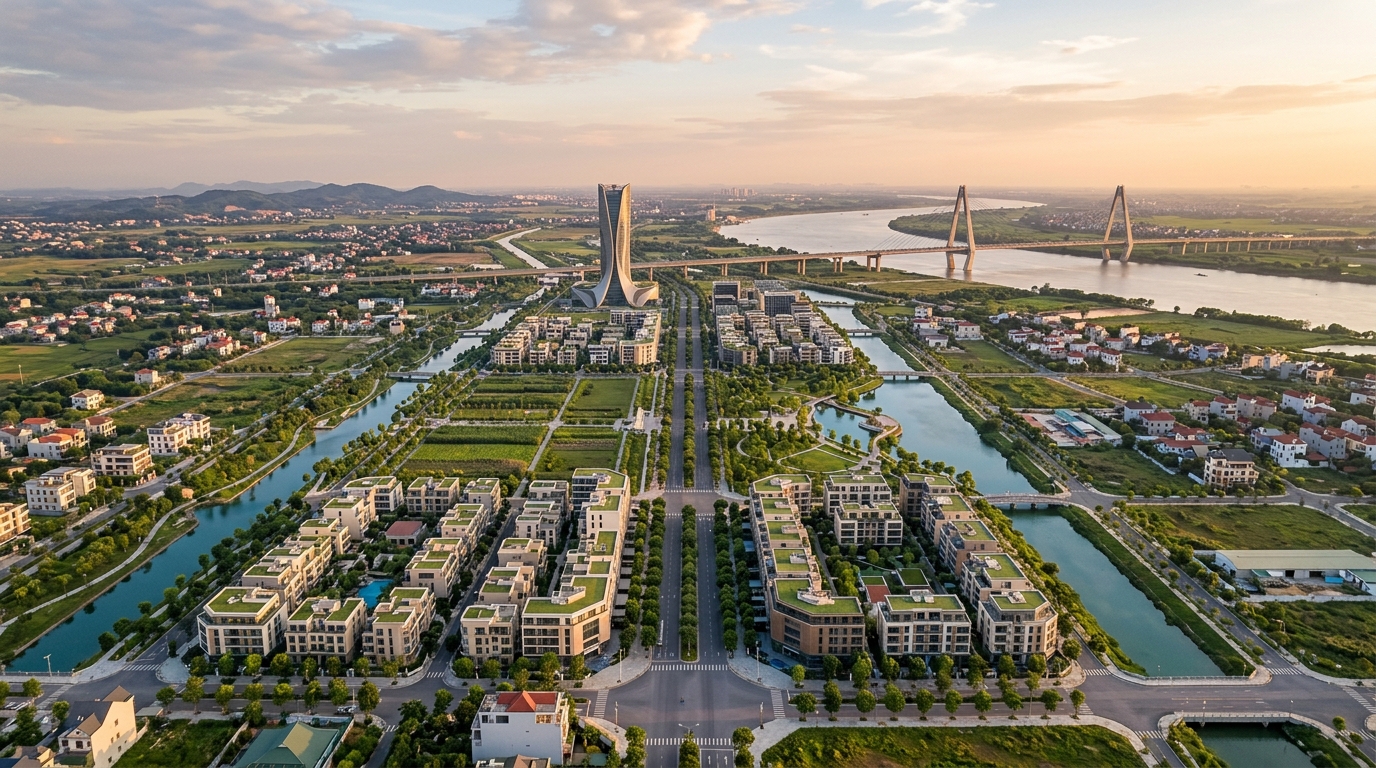
Exclusive luxury living environment within a smart waterfront villa community in Dong Anh, embodying progressive residential standards for elite investors.
From a financial portfolio perspective, prime waterfront residential assets demonstrate superior liquidity retention and resilient secondary yields. The following comparative financial model illustrates capital allocation efficiency between a 100% equity disbursement versus a disciplined 50% leverage strategy supported by a 24-month zero percent interest grace period for a premier property valued at 15.0 billion VND:
Financial Metric
Scenario 1: 100% Cash Equity
Scenario 2: 50% Prudent Leverage (24-Month Grace)
Initial Equity Disbursed
15.0 Billion VND
7.5 Billion VND
Bank Debt Incurred
0 VND
7.5 Billion VND (0% Interest for 24 Months)
Debt Service Burden (Years 1-2)
0 VND
0 VND (Developer Subsidized)
Expected 2-Year Capital Gain (22%)
3.3 Billion VND
3.3 Billion VND
Return on Equity (ROE over 24 Months)
22.0% / 2 Years
44.0% / 2 Years
Stable Net Rental Yield
4.8% / Year (720 Million VND)
Offsets debt service post grace period
Liquidity Reserve Cushion
Moderate (100% Capital Committed)
Exceptional (7.5 Billion VND liquid capital retained)
Quantitative modeling reveals that structured 50% leverage doubles the investor return on equity from 22% to 44% over the initial two-year cycle, while maintaining 7.5 billion VND in liquid capital reserves. The projected recurring rental revenue of 720 million VND annually upon handover serves as a robust fiscal hedge, comfortably servicing subsequent floating interest payments.
5. Legal Due Diligence and Capital Deployment Discipline for Private Investors
The regulatory transition to market-based land valuations taking effect in 2026 under the Land Law 2024 mandates rigorous discrimination between genuine real estate assets and speculative paper developments across Dong Anh. Private investors deploying substantial capital must enforce four non-negotiable asset preservation principles:
First, prioritize developments that have finalized statutory land use fee obligations with the municipal treasury. Projects holding formal administrative land allocation decrees and settled land use tax receipts under historical fee schedules are immune to forthcoming land price hikes, guaranteeing competitive primary pricing and timely issuance of individual ownership titles (pink books).
Second, audit valid construction permits and certified foundation inspection protocols for all off-plan commercial developments. Under Article 24 of the Law on Real Estate Business 2023, developers raising client capital through loan pacts or investment partnership contracts prior to municipal sales authorization commit statutory violations that place purchaser capital at severe default risk.
Third, avoid chasing speculative auction land driven by transient market manipulation. Recent public land auctions in Dong Anh revealed instances where speculative bidding syndicates doubled statutory baseline prices only to forfeit deposit commitments, generating artificial market euphoria. Disciplined capital allocators focus on master-planned communities executed by institutional developers, where property values are grounded in integrated healthcare, international schools, and managed parklands.
Fourth, enforce strict cash-flow utility criteria across every acquired asset. Long-term property holdings must demonstrate achievable rental yields of at least 4.5% annually or sit directly along active commercial thoroughfares, eliminating the liquidity freeze common to deserted plots devoid of civic utilities.
6. Frequently Asked Questions on Dong Anh Real Estate 2026
Personal note from Ms. Bùi Nguyệt Minh: The Dong Anh luxury real estate landscape presents a historic window of opportunity for capital allocators who combine generational vision with disciplined financial modeling. To identify vetted property holdings aligned with your family wealth preservation objectives, please connect directly 1-on-1 with Nguyệt Minh via Hotline/Zalo at 0938.597.199 to structure an optimized and safe real estate acquisition strategy.




 Empirical evidence reference: Excerpted from official reporting by CafeF detailing the 5-phase development timeline of the North Hanoi Smart City and 108-story Financial Tower.
 Exclusive luxury living environment within a smart waterfront villa community in Dong Anh, embodying progressive residential standards for elite investors.